How Server Ransomware Outruns Traditional Detection

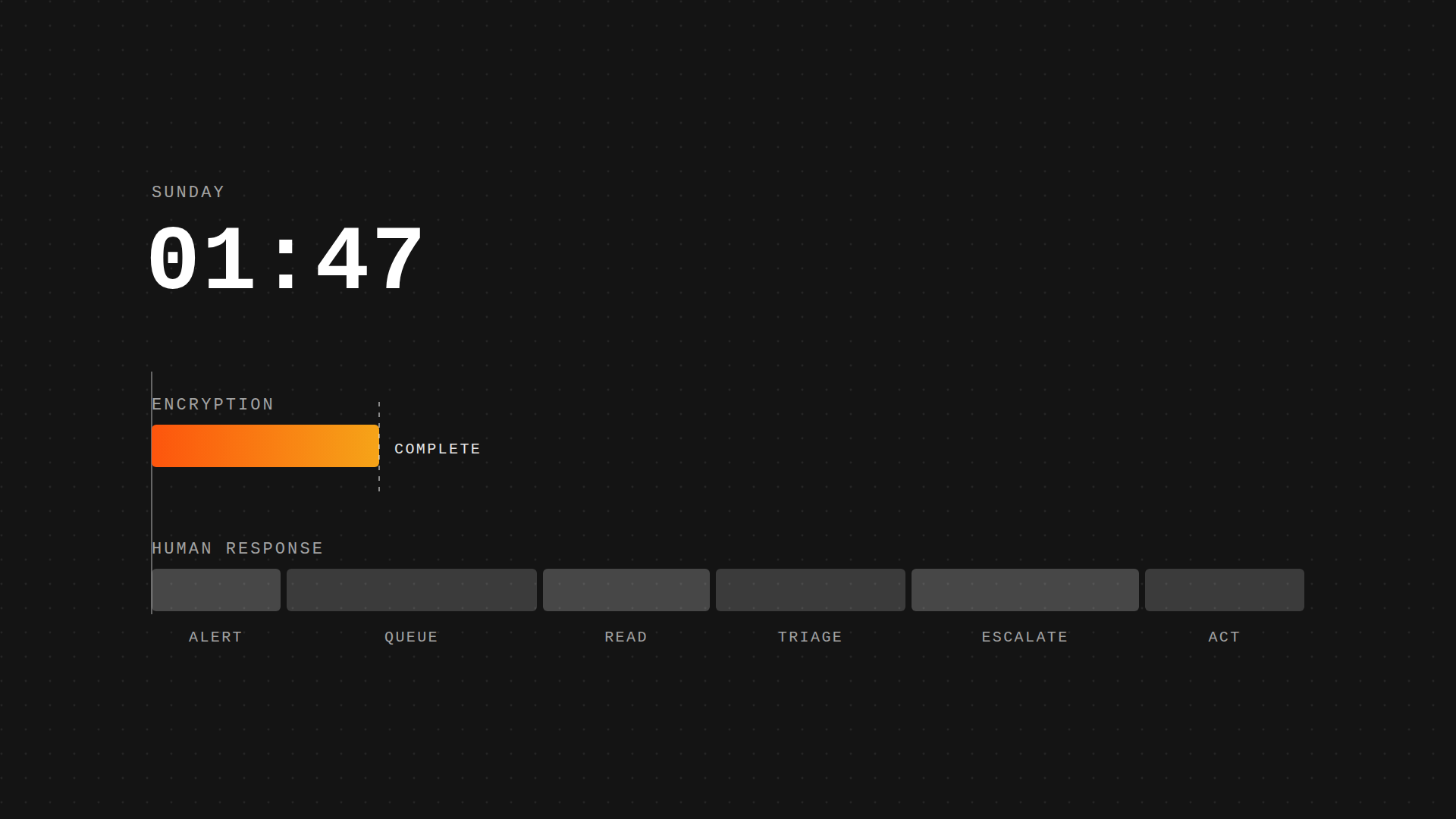
At 1:47 on a Sunday morning, a process on a file server starts rewriting documents. Users notice nothing, and by the time anyone opens a ticket the attack has run for an hour; at the fastest measured encryption rates, an hour of encryption across a handful of servers means millions of files.
Every stage of a human-driven response takes minutes to hours, while the final phase of a ransomware attack completes in seconds, and attackers schedule that phase for nights and weekends, when human response is slowest.
Key takeaways
- Ransomware operators prepare quietly for days, then encrypt in minutes: in Splunk SURGe's benchmark of 400 ransomware executions, the fastest sample encrypted roughly 100,000 files in 4 minutes and 9 seconds, about 25,000 files a minute.
- Detonation is scheduled for off-hours: the Sophos Active Adversary Report 2026 found 88% of ransomware encryption occurred outside business hours.
- Attacks are getting faster: Mandiant's M-Trends 2026 puts the median hand-off from initial compromise to a follow-on actor at 22 seconds.
- A human response pipeline (alert, queue, triage, escalation, action) takes minutes to hours per stage.
- Closing the gap requires real-time storage-layer monitoring and automated containment that acts in seconds, at any hour, without a person in the loop.
The attack timeline: preparation and detonation
A server ransomware attack has two phases. The first is deliberately slow: gain access, map the network, harvest credentials, find the backups, stage tooling. The goal is maximum leverage without triggering a response.
The second phase is as fast as the operator can make it. Encryption launches across file servers, virtual machines, and shares simultaneously, and the attacker no longer cares about being detected, because detection changes nothing unless a response follows within seconds.
Preparation times are also getting shorter. Sophos measured a median of 3.4 hours from the start of an intrusion to reaching Active Directory, and a median dwell time of three days in its Active Adversary Report 2026. Mandiant's M-Trends 2026 puts the global median at 14 days.
Encryption speed in numbers
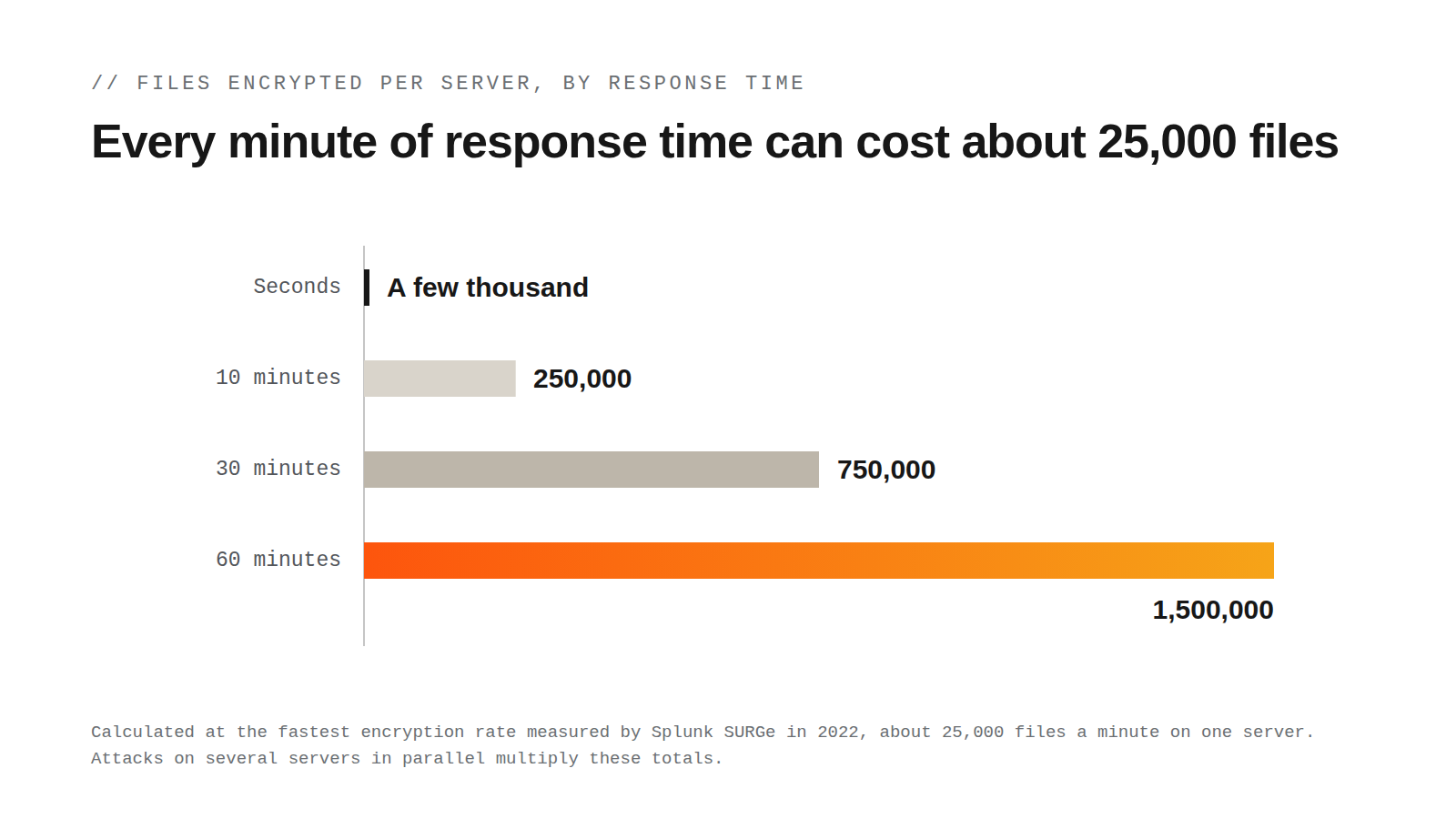
Splunk SURGe benchmarked 400 ransomware executions across major families. The fastest sample encrypted roughly 100,000 files in 4 minutes and 9 seconds, about 25,000 files a minute, while the median across families was about 2,300 files a minute and 43 minutes for the full corpus. Check Point measured the Rorschach variant at 220,000 files in 4.5 minutes. Server attacks run encryption in parallel on every host the operator controls.
At the fastest measured rate on five servers at once, a ten-minute response, exceptional for a human team at 2 a.m., still allows about 1.25 million files to be encrypted, and a sixty-minute response allows more than seven million.
Detonation is timed for off-hours
Attackers schedule detonation for the hours when response is slowest. The Sophos Active Adversary Report 2026 found that 88% of ransomware encryption occurred outside business hours.
At night, on weekends, and before holidays, queues are thinly staffed, escalation means phoning people who are asleep, and a disruptive action needs a decision-maker's approval first. Encryption proceeds at the same speed at any hour, while the human response takes far longer at night.
Your response pipeline, stage by stage
A realistic time budget includes every stage between the first malicious file write and the action that stops it.
- Alert generated. A control that detects the activity produces an alert within seconds to minutes.
- Alert queued. The alert enters a SIEM queue among hundreds of others, and off-hours it can go unread for a long time.
- Alert read. Reading it takes minutes in a staffed SOC and far longer on a Saturday night with on-call coverage.
- Triage. The analyst confirms the alert is real and identifies the host and the account, which takes more minutes.
- Escalation. The analyst wakes an incident lead, who may need an owner's authorization.
- Action. Someone isolates the host, disables the account, or kills the process.
Each stage is individually reasonable, but summed the pipeline takes tens of minutes to several hours, and off-hours responses take the longest. Even at Splunk SURGe's median pace the encryption finishes before an off-hours pipeline does.
Volume destroyed equals the encryption rate multiplied by the time-to-cut, the interval from the first malicious write until writes stop. At 25,000 files a minute, 30 minutes of encryption destroys roughly 750,000 files, while a response measured in seconds limits the loss to a few thousand. Restore time depends on volume, so the response interval determines how long recovery takes.
Every stage of the attack is getting faster
Mandiant's M-Trends 2026 reports that the median hand-off from initial compromise to a secondary actor, often a ransomware affiliate, fell to 22 seconds in 2025, down from more than eight hours in 2022. CrowdStrike's 2026 Global Threat Report puts average breakout time at 29 minutes, with the fastest observed at 27 seconds.
Attackers also spend preparation time disabling detection. ESET research from March 2026 tracks nearly 90 EDR-killer tools in active use, and CISA and Lumu Technologies report that 48% of ransomware attacks successfully disable EDR or XDR. Many attacks therefore start the encryption phase with endpoint alerting already disabled.
The gaps a security leader has to close
These numbers show three gaps, and adding capacity to the existing pipeline does not close any of them.
Real-time visibility at the storage layer
Server ransomware must read, rewrite, and rename files at abnormal speed on the shares, virtual machines, and database servers; it cannot avoid touching the data. Monitoring at the storage layer observes that activity directly, and covers legacy systems that cannot run a modern agent.
Response without a human in the loop
Any control whose response depends on a queue and a person takes as long as the pipeline described above. The response to active encryption has to be automated: detect the illegitimate encryption, isolate the compromised user and device, revoke access, halt the process, then notify the team. People still run the investigation and the recovery; the containment action completes before they are involved. In a documented incident in March 2026, 8.9 seconds passed from the first malicious file event to full containment, with 14 files touched.
Coverage that is identical at 2 a.m.
With 88% of encryption occurring outside business hours, a control that performs differently on a holiday weekend than on a Tuesday morning covers only the remaining 12%. The control itself has to provide the same coverage at any hour, without depending on staffing.
BullWall Ransomware Containment runs agentless from a single virtual machine, monitors data activity at the storage layer across on-premises, cloud, and hybrid estates, and detects and responds in under one second, isolating the compromised user and device, revoking access, and halting the malicious process. It runs 24/7 unattended and works alongside EDR and backups as the layer between prevention and recovery.
Measuring your own time budget
The exercise takes an afternoon: timing the pipeline from a recent incident or tabletop, alert generated, queued, read, triaged, escalated, acted on, once for a Tuesday morning and again for 2 a.m. on a holiday weekend, using real rosters. Multiplying the off-hours total, in minutes, by the fastest measured rate of about 25,000 files a minute per affected server gives the exposure, expressed in files.
The remaining questions concern the stack itself: what watches the storage layer, where server encryption executes, and what is authorized to act in seconds without a person. If nothing in the stack does that, the time budget above is the current exposure.
FAQs
How fast does ransomware encrypt files on a server?
In Splunk SURGe's benchmark of 400 ransomware executions, the fastest sample encrypted roughly 100,000 files in 4 minutes and 9 seconds, about 25,000 files a minute, and the median across families was about 2,300 files a minute. Server attacks typically run encryption on several hosts in parallel, multiplying those rates estate-wide.
Why do ransomware attacks happen at night and on weekends?
Attackers schedule detonation for the hours when response is slowest. The Sophos Active Adversary Report 2026 found 88% of ransomware encryption occurred outside business hours, when queues are unwatched and escalation means waking people. Off-hours coverage therefore has to be automated.
What is the average dwell time before ransomware is deployed?
Sophos measured a median dwell time of three days across its 2026 incident response caseload, and Mandiant's M-Trends 2026 puts the global median across all intrusion types at 14 days.
Can a SOC respond fast enough to stop server-side encryption?
A human-driven pipeline alone is too slow: triage, escalation, and approval each take minutes to hours, while the fastest measured ransomware encrypts about 25,000 files a minute per machine. A SOC remains essential for investigation and recovery, but stopping active encryption requires an automated layer such as BullWall Ransomware Containment, which detects and responds in under one second.
How does automated ransomware containment stop an attack in progress?
BullWall Ransomware Containment monitors data activity at the storage layer from a single agentless virtual machine, using heuristics, file metadata, and a machine-learning baseline of normal access. When it detects illegitimate encryption, it isolates the compromised user and device, revokes access permissions, and halts the malicious process in under one second, then alerts the team.