The Cyber Assessment Framework


Why CAF 4.0 Demands a Ransomware-First Mindset -- and How BullWall Delivers It
The CAF 4.0 Challenge for Executives
CAF 4.0 isn't just another compliance checklist. Regulators are looking for evidence that organisations can withstand realistic, high-impact threats and keep essential functions running.
Traditional prevention and detection tools remain critical--but they weren't designed to instantly stop ransomware encryption once it starts. That is the "blast radius" moment CAF 4.0 is pressing leaders to address.
WITHOUT A PROVEN CONTAINMENT LAYER, RANSOMWARE CAN ESCALATE FROM A SINGLE COMPROMISED ENDPOINT INTO AN OPERATIONAL CRISIS WITHIN MINUTES.
How BullWall Aligns to CAF 4.0 Outcomes
BullWall doesn't try to cover every CAF principle--but it delivers laser-focused resilience where the framework and regulators are most concerned: stopping ransomware before it impacts essential services.
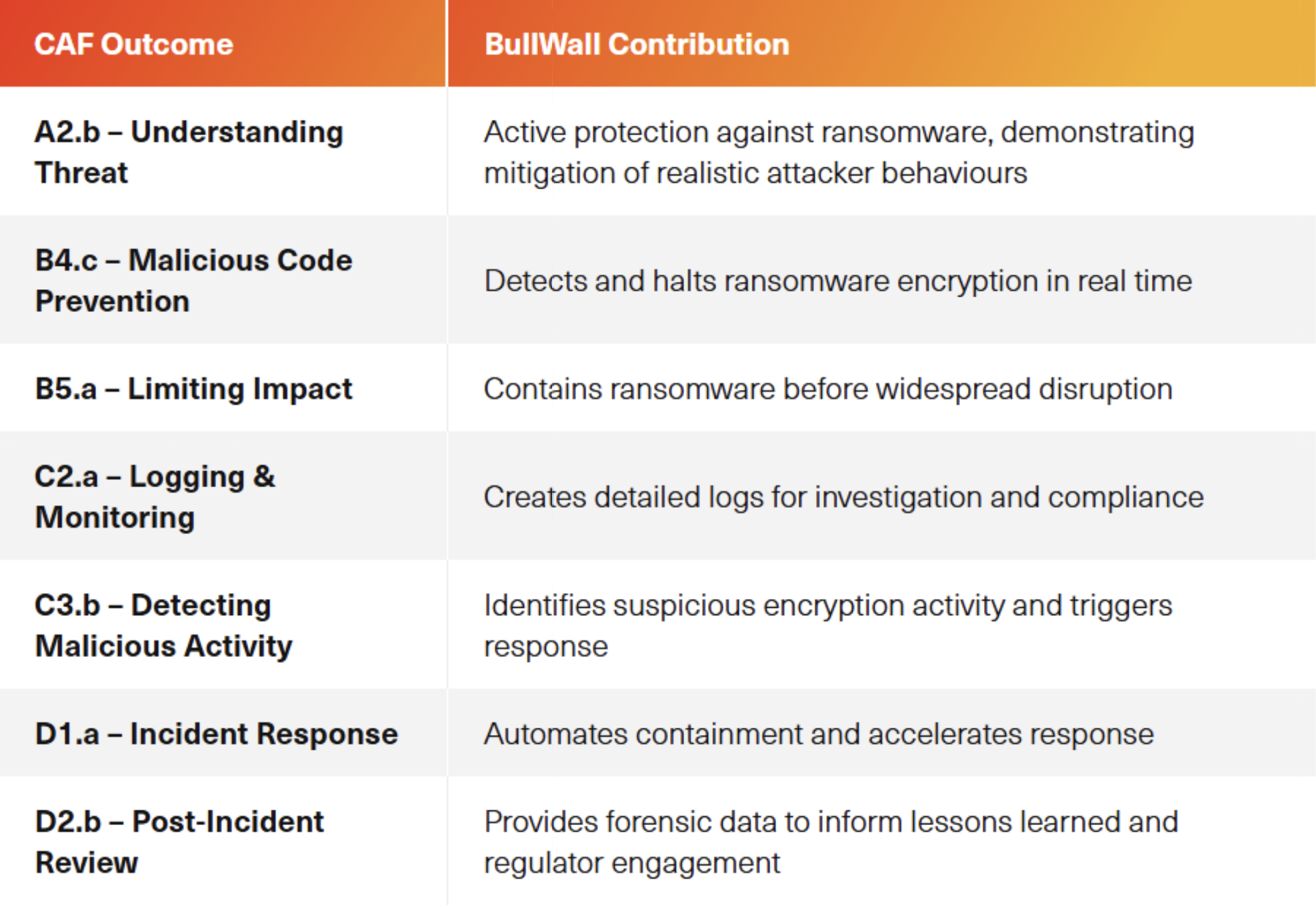
Here's how BullWall maps directly to CAF outcomes that matter to executives and regulators alike:
Objective A: Managing Security Risk
A2.b: Understanding Threat
- CAF requires boards to show they understand and mitigate realistic attacker behaviours.
- BullWall demonstrates this in practice by actively protecting against ransomware, one of the most prevalent and damaging attack scenarios.
Objective B: Protecting Against Cyber Attack
B4.c: Malicious Code Prevention
- Detects and stops ransomware encryption attempts in real time.
- Automatically isolates compromised users or endpoints, preventing spread across the network.
B5.a: Limiting Impact of Attacks
- Stops ransomware before mass encryption occurs.
- Protects critical operational data and ensures continuity of essential services.
Objective C: Detecting Cyber Security Events
C2.a: Logging & Monitoring
- Produces detailed logs of ransomware activity.
- Gives full visibility into who attempted encryption and on what system--supporting rapid, regulator-ready investigations.
C3.b: Detecting Malicious Activity
- Identifies unauthorized encryption patterns--the clearest sign of a ransomware compromise.
- Triggers immediate alerts and automated containment.
Objective D: Minimising Impact of Cyber Security Incidents
D1.a: Incident Response
- Automates incident response by quarantining compromised assets.
- Provides forensic-quality data to accelerate recovery and regulatory reporting.
D2.b: Post-Incident Review
- Supplies granular logs of what was targeted, who was affected, and how the attack unfolded.
- Enables organisations to prove to regulators that ransomware threats are understood, prepared for, and managed effectively.
Summary at a Glance
The Executive Takeaway
CAF 4.0 makes it clear: ransomware is not just an IT risk--it's a board-level resilience risk. Regulators now expect evidence that you can detect and contain it in real time, not after the damage is done.
BullWall delivers that evidence. By detecting and stopping unauthorized encryption instantly, BullWall:
- Strengthens cyber resilience against one of the most damaging threats in today's landscape.
- Directly supports CAF outcomes across risk management, protection, detection, and response.
- Provides the forensic logs needed for compliance, regulator engagement, and continuous improvement.
For C-level executives, this isn't just about compliance. It's about protecting your ability to deliver essential services, safeguarding your reputation, and showing regulators you're prepared for the attacks that matter most.
With CAF 4.0 setting a new standard, the question isn't whether ransomware will test your defences--it's whether your organisation can stop it in time.
With BullWall in your security stack, the answer is yes.