Why Ransomware Detection Misses Server Encryption

A common ransomware incident now ends with a file server fully encrypted overnight while the EDR console records no alerts and every agent reports healthy. The endpoint stack did not malfunction; none of the machines it watched did anything wrong.
The cause is architectural, and tuning or staffing cannot correct it. Endpoint detection watches processes on devices, while operators now target the data on servers and shares and run the encryption from a position device-level tools cannot act on. Five structural features of endpoint-focused, signature-driven tooling account for the gap, and automated containment at the storage layer closes it.
Key takeaways
- Endpoint detection watches processes where agents run; server-side encryption is file activity on storage.
- Remote encryption over SMB never puts a payload on the server. Sophos recorded a 141% rise in remote ransomware between 2022 and 2024.
- Encryption with stolen credentials is an authenticated session doing permitted file operations, leaving nothing for a signature to match.
- Attackers disable agents first: ESET tracks nearly 90 EDR-killer tools in active use, and CISA and Lumu report 48% of attacks disable EDR or XDR.
- A control watching data behavior at the storage layer sees the encryption itself, regardless of device, variant, or agent state.
Detection runs on the endpoint while the damage happens on storage
EDR is built around a placement decision: install an agent on each device and watch what executes there. The design assumes malicious activity will happen on a machine the agent can see.
Server-side encryption falls outside that assumption, because business-critical data is stored on shares, database servers, virtual machines, and cloud repositories, and any machine with a mapped drive and valid credentials can rewrite it. The agent on a file server watches that server's own processes; it has no model of what ten thousand files being rewritten across a share should look like.
Remote encryption leaves nothing on the server to detect
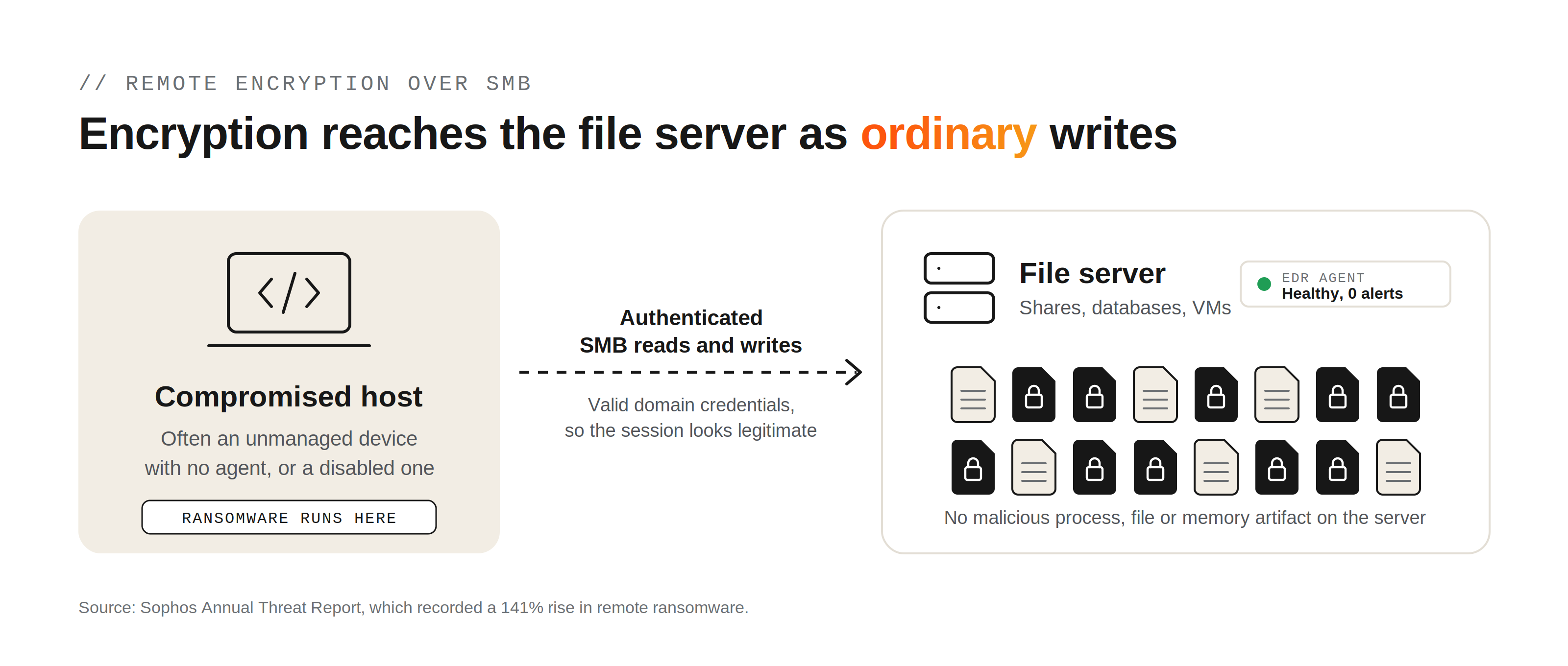
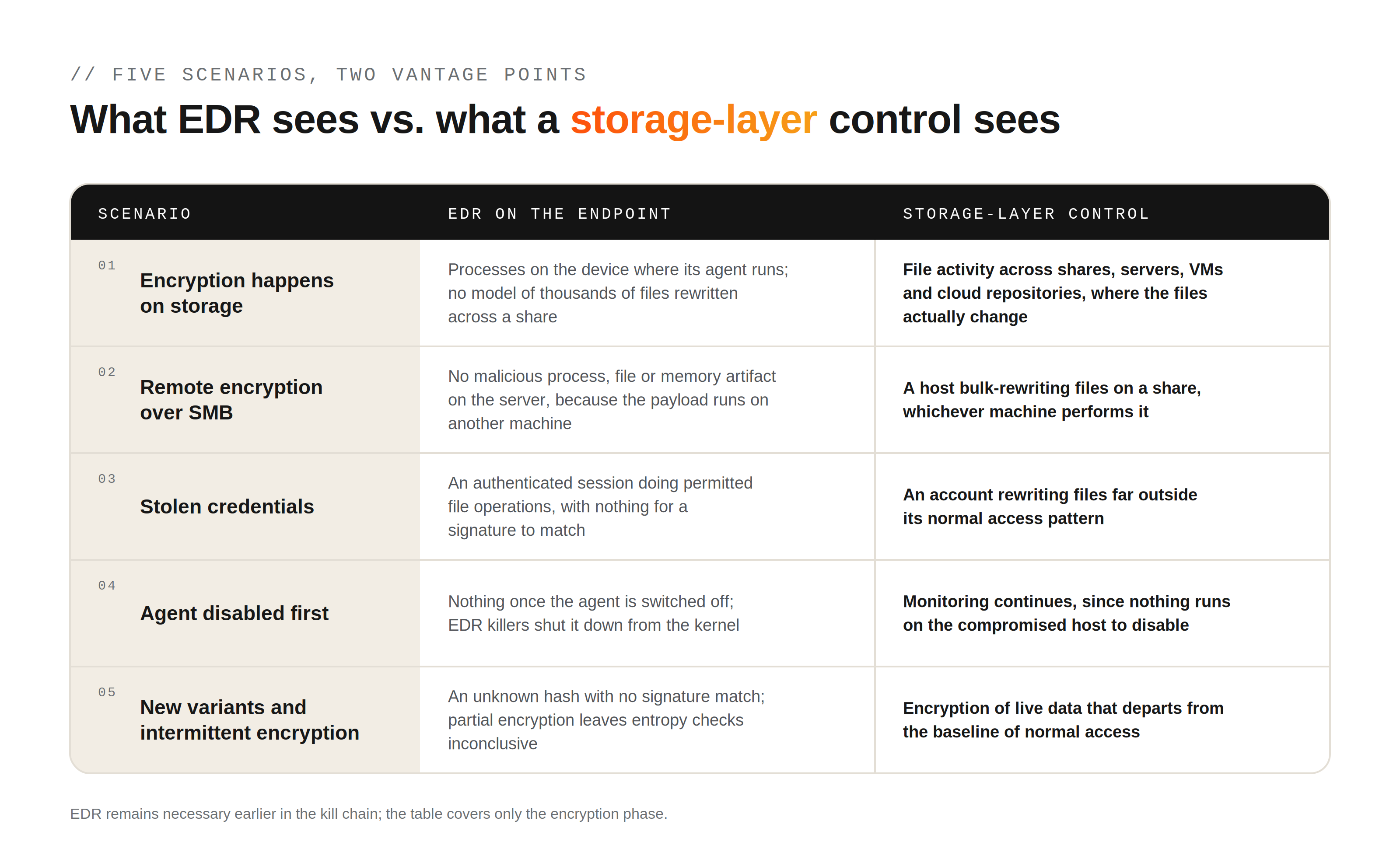
The most direct exploitation is remote encryption: the attacker compromises one machine and uses it to encrypt data on servers over SMB. Files are read over the network, encrypted on the compromised host, and written back. The ransomware binary never touches the server, so there is no malicious process, file, or memory artifact on the server for an agent to find. On the server, the attack consists of ordinary file I/O from an authenticated session.
Sophos CryptoGuard research found around 60% of human-operated ransomware attacks in 2023 involved remote encryption, roughly 80% of them originating from unmanaged devices. The Sophos Annual Threat Report 2025 recorded a 141% rise in remote ransomware since 2022, and Akira, LockBit, BlackCat, Royal, and Black Basta all ship it as a built-in option. Sophos researchers note that most endpoint security products only monitor for encryption locally, so one unprotected laptop is enough for the attack.
Stolen credentials make encryption look like normal activity
Remote encryption depends on credentials, which attackers obtain routinely: phished passwords, reused service accounts, or tokens taken in an earlier compromise. With a valid domain account, authentication and access control both pass, and the server treats the session as legitimate.
Signature-driven tooling checks whether a file or process is known bad; on the server there is no malicious file and no suspicious process. The remaining signal is the account's behavior, since an account that rewrites forty thousand files overnight is operating far outside its normal pattern. Endpoint agents do not model account behavior against storage.
Attackers disable the agent first
Even where an agent is present and well configured, attackers plan for it: disabling endpoint protection is now a standard early step in the intrusion. ESET research from March 2026 tracks nearly 90 EDR-killer tools in active use across major ransomware groups, many using vulnerable signed drivers to shut down protection from the kernel. CISA and Lumu Technologies report that 48% of ransomware attacks successfully disable EDR or XDR.
EDR remains necessary and stops a great deal earlier in the kill chain. The structural limitation is that a control running inside a machine the attacker administers can be switched off, so detection for the encryption phase has to run where the compromised host cannot reach.
Signatures fail against new variants and intermittent encryption
The remaining element of the traditional model is recognition: matching the binary, hash, or behavior to something seen before. Ransomware-as-a-service groups rebuild payloads per campaign, so the hash is new by design. Intermittent encryption, used by LockBit and others, encrypts only part of each file: the data is destroyed just as thoroughly, but the I/O load is lighter, entropy checks are less conclusive, and threshold-based logic sees nothing resembling the full-file encryption it was trained on.
Together these factors produce a blind spot: the binary is new, so no signature matches; the attack launches from a machine with no agent or a disabled one; the credentials are valid, so the server sees a legitimate session; and the encryption is partial, so even entropy heuristics are inconclusive. Each defense does the job it was designed for, and none of those jobs covers encryption performed against storage over an authenticated session.
The signals available earlier in an intrusion, a suspicious login or an unusual process, are authorized actions that might be malicious, and no organization automates a destructive response on that ambiguity. A valid session bulk-rewriting files on a share is unambiguous, so automated response is defensible at that stage.
Closing the gap at the storage layer
The encryption happens on storage, so detection has to watch the data there. BullWall Ransomware Containment monitors at that layer, agentless, with nothing installed on endpoints, servers, or devices; it runs on a single virtual machine and watches file activity across the estate: SAN and NAS shares, virtual machines, domain controllers, database and application servers, and cloud repositories (Office 365, SharePoint, OneDrive, Google Drive). Detection combines heuristics and file metadata with a machine-learning baseline of normal access.
Because the encryption is visible where the files change, which machine performs it is irrelevant. Valid credentials do not prevent detection, because the baseline flags the file behavior whichever account performs it. New variants and intermittent encryption are also caught, because illegitimate encryption of live data does not match any normal user activity, and a compromised host has no agent to disable. Splunk SURGe's fastest measured sample encrypted roughly 100,000 files in 4 minutes and 9 seconds, about 25,000 files a minute, and Check Point clocked Rorschach at 220,000 files in 4.5 minutes, so the response is automatic: detection and containment in under one second, isolating the compromised user and device, revoking access, halting the activity, alerting the team, and inventorying affected files for recovery.
Evaluating your own exposure
Four questions show whether the blind spot exists. If an unmanaged device started encrypting a file share over SMB, what would see it? Can the stack distinguish a compromised account from a legitimate one at the file-activity layer? If the agent on a compromised host is disabled first, what remains? Is the response automatic, or does it require a person to act?
The answers usually point to a gap between prevention and recovery: EDR and backups both stay essential, and neither watches the data while it is encrypted. A containment layer like BullWall's can be evaluated with one virtual machine; most implementations finish in days, and nothing changes on endpoints or servers.
FAQs
Why doesn't my EDR detect ransomware encrypting our file servers?
In a remote encryption attack the malicious process never runs on the server: a compromised host elsewhere encrypts the files over SMB, so the server sees only authenticated reads and writes. EDR watches processes where its agents run; a storage-layer control such as BullWall Ransomware Containment covers it by watching the file activity itself.
What is remote ransomware encryption and why is it hard to detect?
Remote encryption is when ransomware on one compromised machine encrypts files on other systems, leaving no payload on the servers that hold the data. It is hard to detect because most endpoint products only monitor encryption locally, and the attack usually launches from a device with no agent.
Can attackers disable EDR before deploying ransomware?
Yes. ESET research from March 2026 tracks nearly 90 EDR-killer tools in active use, and CISA and Lumu Technologies report 48% of ransomware attacks disable EDR or XDR. BullWall runs agentlessly at the storage layer, so there is nothing on the compromised host to kill.
How does storage-layer ransomware containment work without agents?
BullWall Ransomware Containment runs on a single virtual machine and watches file activity across shares, servers, and cloud repositories. Heuristics, file metadata, and a machine-learning baseline of normal access identify illegitimate encryption, and it responds in under one second by isolating the compromised user and device, revoking access, and halting the activity. Nothing is installed on endpoints or servers, so any OS is covered, legacy systems included.
Do I still need EDR if I deploy BullWall Ransomware Containment?
Yes. EDR stops a large share of attacks earlier in the kill chain, and backups remain essential for recovery. BullWall is the complementary layer between the two: it stops active encryption at the storage layer when prevention is bypassed, so the damage stays small enough for recovery from backups to be practical.