Agentless Ransomware Containment for Business Continuity

Most organizations hit by ransomware stay in business and lose weeks of operation. File shares are encrypted, order systems stop, and staff work from spreadsheets while IT rebuilds. The Sophos State of Ransomware 2025 report puts the average recovery bill at $1.53 million before any ransom is paid, and 18 percent of victims needed more than a month to fully recover. For a given organization, the exposure is its daily revenue multiplied across that recovery period.
NIS2 and DORA set incident-reporting deadlines measured in hours, GDPR requires breach notification within 72 hours, and insurance questionnaires ask how quickly an organization can stop active damage and document what happened once prevention fails. Containment, the layer between prevention and recovery, is the control that stops the damage and produces the documentation.
Key takeaways
- Ransomware's largest cost is business interruption. IBM's Cost of a Data Breach 2025 puts the average total cost of a ransomware incident at $5.08 million including downtime, remediation, and business interruption.
- NIS2, DORA, and GDPR set reporting deadlines measured in hours, and insurers ask how active encryption is stopped once it begins.
- Whether an incident stays a service-desk matter or becomes a company-wide outage depends on how much data was encrypted before the attack was stopped.
- Agentless containment monitors the storage layer from one virtual machine, covering file shares, virtual machines, databases, legacy systems, and cloud repositories with no software to deploy.
- BullWall Ransomware Containment isolates the compromised user and device in under a second, inventories affected files for scoped recovery, and generates reports mapped to GDPR, NIS2, DORA, NIST, and insurer requirements.
Downtime is the largest cost
The ransom itself is usually the smaller number. Sophos reports a median payment of $1 million in 2025, against an average recovery cost of $1.53 million excluding the ransom, and IBM's Cost of a Data Breach 2025 puts the average total cost of a ransomware incident at $5.08 million once downtime, remediation, and business interruption are counted. Verizon's 2026 Data Breach Investigations Report found that 48 percent of confirmed breaches involve ransomware, the highest share in the report's history.
Public reporting on the September 2025 attack on Jaguar Land Rover shows the scale at the high end: production halted for about five weeks, and the UK Cyber Monitoring Centre modeled the UK-wide cost at around £1.9 billion, roughly £108 million per week of halted production, with more than 5,000 organizations affected downstream.
These costs scale with the number of files encrypted. Restoring 50 encrypted files takes an afternoon, while 5 million files across 40 servers can take a quarter. In Splunk SURGe's encryption-speed testing, the fastest sample encrypted roughly 100,000 files in 4 minutes and 9 seconds, about 25,000 files a minute, so the scope of an incident is set within its first minutes, before any human has responded.
Reporting deadlines and insurer questions
GDPR gives you 72 hours to notify the supervisory authority of a personal data breach, and the notification must describe scope. NIS2 requires an early warning within 24 hours of a significant incident and a fuller notification within 72. DORA requires financial entities to file an initial incident report within hours. None of these deadlines can be met by an organization still working out which systems were touched.
Insurers pay the downtime bill, and their questionnaires increasingly ask how quickly active encryption is detected and stopped, whether response is automated, and what evidence would support a claim. CISA and Lumu Technologies report that 48 percent of ransomware attacks successfully disable EDR or XDR, and ESET reported in March 2026 that nearly 90 EDR-killer tools are in active use across major ransomware groups.
Containment limits destruction and downtime and restores availability. Data an attacker has already copied out is not recovered, and the notification deadlines apply regardless.
The difference between a small incident and a company-wide outage
A ransomware incident touching one user account and a few hundred files is handled by the service desk: the account is isolated, the files restored, and the incident reviewed. The same intrusion left running for an hour becomes a company-wide outage with a crisis team, external counsel, and regulator notifications. The only difference between the two outcomes is how long encryption ran.
Containment speed is therefore a continuity control. If the recovery time objective for core systems is four hours but encryption can spread unchecked for one, the RTO will not be met, because encryption adds files to the recovery workload faster than restores complete.
How agentless containment preserves continuity across mixed storage
BullWall Ransomware Containment is agentless. There is no software to install on endpoints, servers, or devices. It runs on a single virtual machine with read access to monitored data and monitors data activity at the storage layer across the whole estate: SAN and NAS file shares, virtual machines, domain controllers, database and application servers, and cloud repositories including Office 365, SharePoint, OneDrive, and Google Drive. Because it is OS-agnostic, it also covers the legacy systems that cannot run a modern agent.
Detection combines heuristics, file metadata, and a machine-learning baseline of normal access built during an initial learning period. When illegitimate encryption starts, the response takes under one second: the compromised user and device are isolated, permissions revoked, the malicious process halted. Everything else stays up, and the business keeps operating.
Containment produces two records that a continuity program uses. The inventory of affected files limits recovery to a known list. The automated incident reports are mapped to GDPR, NIS2, DORA, NIST, and cyber-insurance requirements and include forensic-quality logs from every containment event, so the regulator notification and the insurance claim can be prepared from material the system has already produced.
The layer between prevention and recovery
Containment does not replace the tools already in place. EDR remains essential for blocking known malware and giving responders endpoint visibility, and backups remain essential because some data will always need restoring. Containment operates between the two, on the assumption that prevention will sometimes fail, and keeps the failure small enough that recovery is routine.
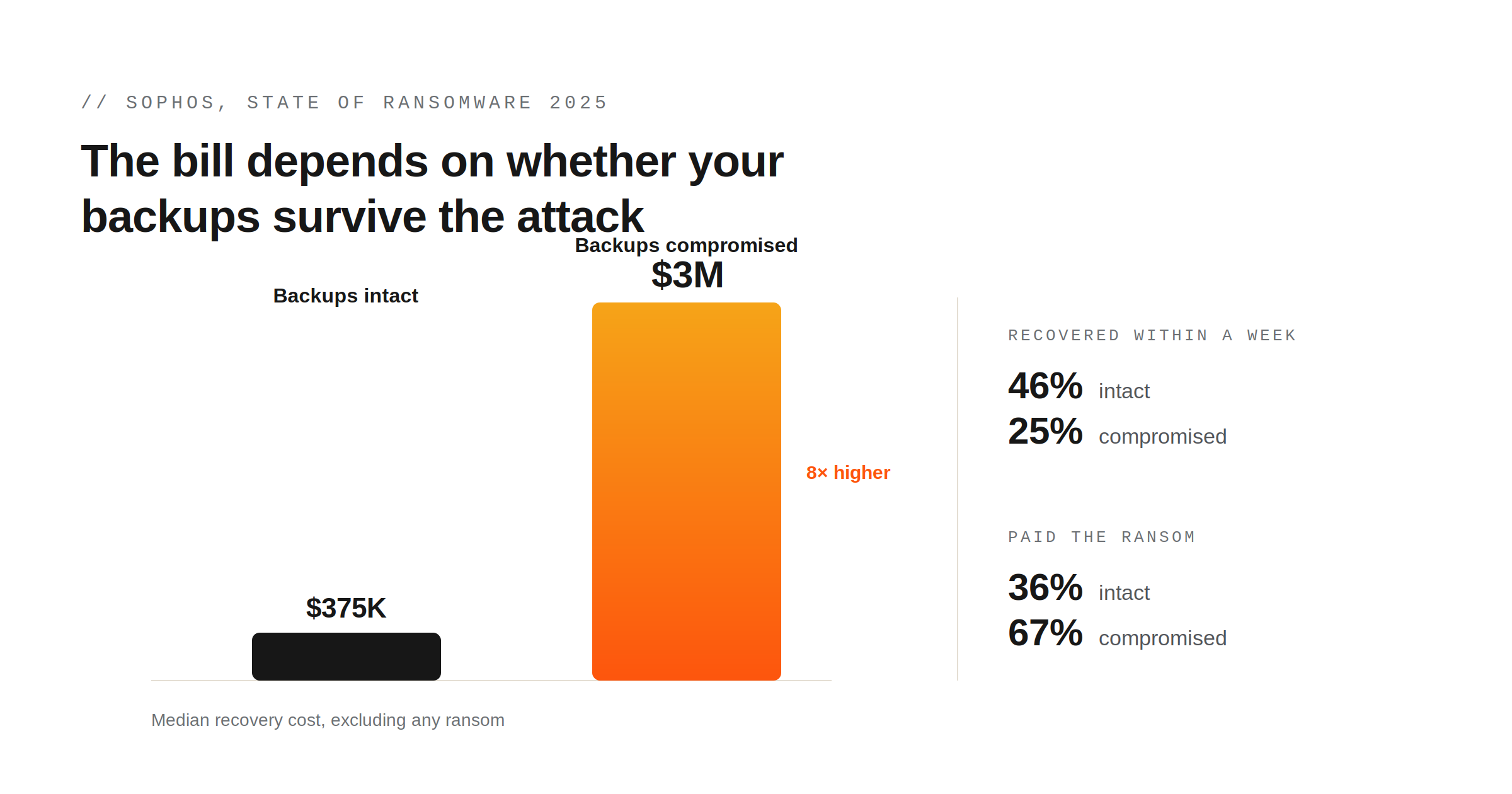
Backups are themselves a target: Sophos found that 94 percent of ransomware incidents included an attempt to compromise the backups, and the outcome depends on whether that attempt succeeded. With backups intact, 46 percent of organizations recovered within a week and 36 percent paid the ransom, at a median recovery cost of $375,000. With backups compromised, 25 percent recovered within a week, 67 percent paid, and the median cost was $3 million. Containment can pause a running backup job before damaged files overwrite the last clean copies.
Evaluating containment for a resilience program
Coverage across your actual estate. Mixed estates with NAS, virtual machines, legacy servers, and cloud repositories are where agent-based coverage breaks down, so check that a tool monitors every place data is stored.
Evidence of response speed. Splunk SURGe's fastest sample encrypted roughly 100,000 files in 4 minutes and 9 seconds, so the relevant evidence is a demonstrated detection-to-isolation time, verified with a simulated attack in the environment the tool would protect.
Fit with the existing stack. Containment events should go to the SIEM and SOC workflow already in place. BullWall integrates through REST API and JSON with pre-configured scripts; most connections complete in under an hour.
Deployment effort. A single-VM, agentless deployment typically finishes in days, with no change to endpoints and no network performance overhead.
A continuity plan with no control between EDR alerts and restoring from backup leaves active encryption running between those two points. A proof of value against a simulated attack shows how much data would be encrypted in that interval in a specific environment.
FAQs
How does ransomware containment fit into a business continuity plan?
Containment keeps a ransomware incident small enough for the rest of the plan to work. It operates between prevention and recovery, stopping active encryption in seconds so recovery objectives stay achievable. BullWall Ransomware Containment fills this layer without adding agents to the systems the plan protects.
What does ransomware downtime cost?
IBM's Cost of a Data Breach 2025 puts the average total cost of a ransomware incident at $5.08 million including downtime, remediation, and business interruption, and Sophos reports 18 percent of victims needed more than a month to fully recover. The largest cost is interrupted operations, and containment reduces the length and scope of the outage.
Do NIS2 and DORA require ransomware containment?
Neither names specific products, but both set reporting deadlines measured in hours and require technical measures that limit incident impact. Meeting a 24- or 72-hour deadline requires knowing what was affected, which is impractical without automated containment and logging. BullWall produces incident reports mapped to GDPR, NIS2, DORA, NIST, and cyber-insurance requirements from every containment event.
Does agentless ransomware containment replace EDR or backups?
No, both remain necessary layers. Containment covers the gap between them: CISA and Lumu report that 48 percent of ransomware attacks disable EDR or XDR, and a restore is only fast when the encrypted set is small. BullWall is designed to run alongside both and sends its alerts into the same SOC workflow.
How long does it take to deploy agentless ransomware containment?
BullWall Ransomware Containment runs on a single virtual machine with read access to monitored data, so there is no endpoint rollout. Most implementations finish in days, followed by a learning period to baseline normal data access. SIEM and SOC integrations use REST API and JSON; most connections complete in under an hour.